Bread, Football, Circuses, Beer and 1000 Cuts
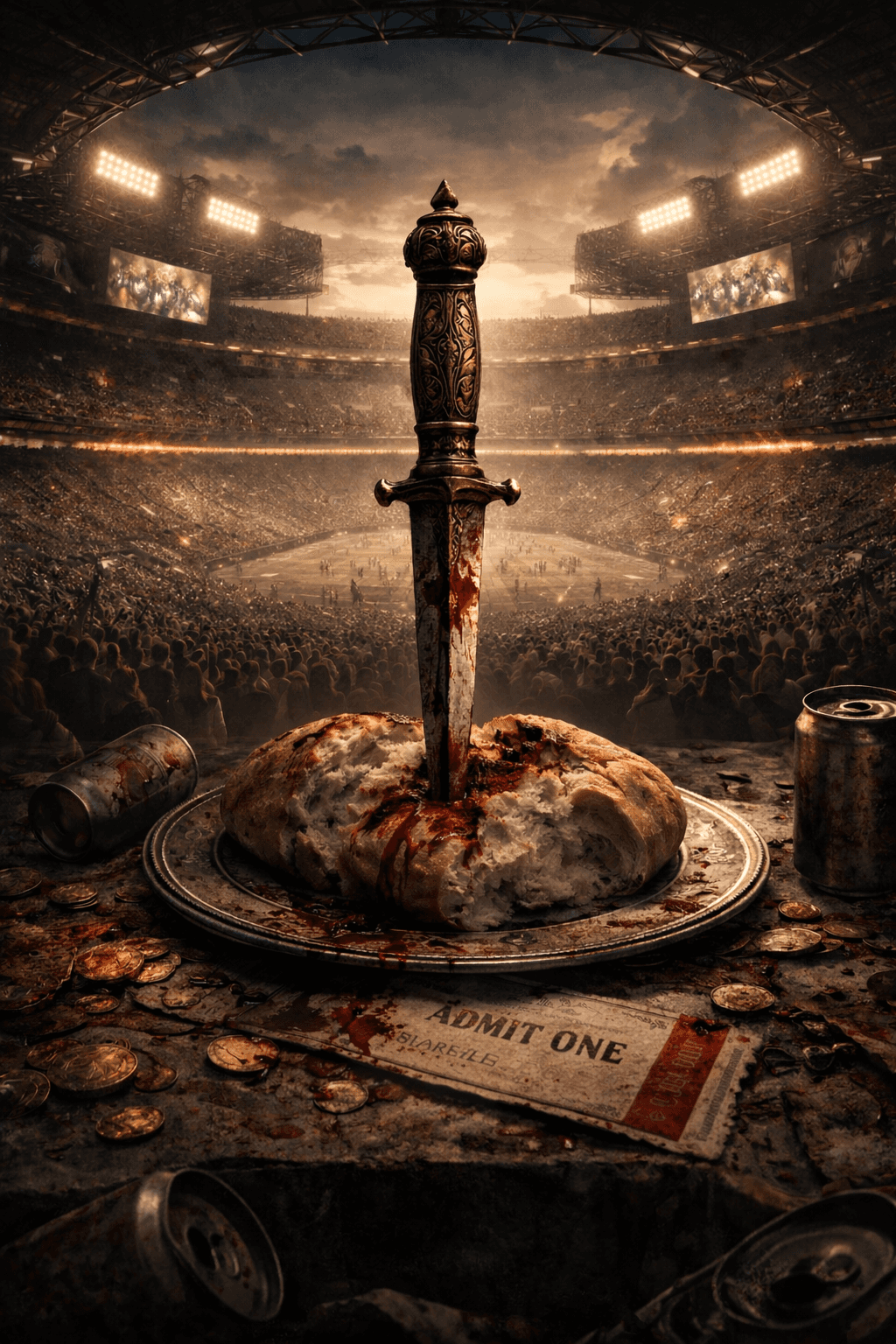
The Stadium Is Full
So here I am, sitting and preparing to watch the Super Bowl, Seattle vs. the Patriots. Do I care who wins? No. And that may be the first lie. The Super Bowl is almost an American tradition, like Friday night lights, overly processed foods, and proxy wars for oil. Rituals so embedded they no longer feel like choices. Nothing special is going on in my home other than my Goldendoodle roaming back and forth, recently diagnosed with an anxiety disorder, pacing without knowing why.
Millions of people will be watching this game across the country, territories, and adjacent cultures that enjoy modern-day gladiatorial battles, fighting for the pigskin in a controlled environment. The Super Bowl in 2026 is set to take place at Levi’s Stadium in Santa Clara, California, a venue that seats roughly 68,500 fans and expands to around 75,000 for major events. A massive open seating bowl designed to pull spectators as close to the spectacle as possible. Rome understood something about proximity and power with their Coliseums.
When that many people are watching, there is a backdrop we collectively ignore. We are pacified by bread and circuses. As the game plays, renewed attention is drawn to court filings and document releases related to Jeffrey Epstein, re-exposing associations between a convicted sex trafficker and influential figures. Hostilities continue to escalate between the United States and Israel against Iran. The president of Venezuela, Nicolás Maduro, has been apprehended and charged in U.S. court as the alleged leader of a drug-trafficking operation, set to stand trial in New York City.
At the same time, protests against Immigration and Customs Enforcement continue across the country. Reports and advocacy groups have highlighted dozens of deaths that have occurred in federal custody over recent years, cases that remain the subject of public scrutiny, investigation, and dispute. Names surface repeatedly in protest: Keith Porter Jr., Silverio Villegas Gonzales, Renee Nicole Goode, Alex Pretti. These events are not hidden. They are simply outpaced.
There are “bad” things happening everywhere, yet the Super Bowl remains the focal point because it is an American spectacle, a space where people are encouraged to put differences aside, except for which team they want to win. Tailgates, drinking, laughter. A temporary binding agent. And beneath it, dread. The kind that comes from sensing a fracture without knowing where it leads. This is not a political essay, but it is not neutral either.
Bread, Circuses, and the Thousand Cuts
This essay moves through pop culture as an administrator of Lingchi, the death of a thousand cuts. Not through brutality, but through comfort. The most dangerous cut is not violence. It is amnesia. We have forgotten that culture was formed to have us challenge power. In recent years pop culture temporarily blinds us to what makes us human by repetition. This repetition replaces friction with familiarity.
People love to argue about the collapse of the Roman Empire and compare it to the imagined collapse of the American one. One of the largest exports of the United States is not oil or weapons, but culture itself: movies, food, aesthetics, ways of life. We are a near-corporatocracy, where business runs everything, and if something cannot be optimized, monetized, or reduced into efficiency, it is restricted, removed or extracted.
So what happens when pop culture no longer functions as passivity? Or more unsettling, why is that passivity no longer enough to keep people happy? What happens when American pop culture is no longer imitated but mocked, no longer aspirational but hollow? When soft power erodes.
The danger is not collapse because that is for books, reality is slow burn. The danger is mutation. A culture that keeps producing references, spectacles, and rituals that no longer bind people together meaningfully, but still demand attention. When internal turmoil becomes too visible for the rest of the world to ignore, and efficiency becomes so total that it strips life of texture.
Consent Disguised as Comfort
So is pop culture what pacifies us? Me watching the Super Bowl, claiming I have no dog in the fight, is that neutrality, or is it consent disguised as detachment? Knowing that this spectacle is one of the thousand cuts, does participation become hypocrisy, or is hypocrisy simply the cost of comfort?
Most people want justice abstractly, but comfort concretely. We don’t die smiling with beer in our bellies. We die numb with beer in our bellies. Numb enough to confuse distraction with peace. I do not sound an alarm here. Pop culture can resemble a utopia. Millions of people set real anxieties aside to focus on a fugazi question of who wins, Seahawks or Patriots. That matters to them, and in that sense, it doe matter. It can create community. It can create memory. It can create a sense of togetherness that opens the door to empathy, compassion, even love. But only if it points outward. Only if it leads somewhere beyond itself. Otherwise, it becomes circular. Self-consuming.
Pop culture is a double-edged sword. It can bind people together in a fractured society, or it can continue cutting, softly and repeatedly, until survival is no longer threatened by catastrophe, but by forgetting why survival mattered in the first place.