For Humans, what is peak density?
The Question
I ask this question because when I travel to larger cities with a bit of a skyline, like Chicago, Atlanta, or New York City, I start thinking about how most of the world is moving toward living in cities. In fact this shift has already happened. According to the United Nations Department of Economic and Social Affairs, more than 55 percent of the global population now lives in urban areas, and that number is projected to rise to 68 percent by 2050 (UN DESA, World Urbanization Prospects, 2018).
So clearly humans are gravitating toward density, probably because it seems that’s where the opportunities are. Now I live in a somewhat rural area, but if I am honest I would much rather live in the city for the cultural aspect. At the same time I appreciate the spacing that homes in more rural environments offer. However that spacing does not always breed community.
Growing Up in Suburbia
I grew up in the clutches of suburbia. It is not necessarily ugly or intrusive compared to some other parts of the country, but it follows a pattern. It is essentially the same home repeated again and again in slightly different variations, often designed for the highest monetary gain from developers. These neighborhoods create a sense of community, but also a strange kind of isolation within that community. People live close to you, but because each home exists on its own individual lot there does not have to be communication. You can live next to someone for years and never really know anything about them, which could be freeing and scary if you think about it. You just hope they are not an awful neighbor ( which I’ve had and it’s awful).
Across the United States development often swings like a pendulum between extremes. One developer swings toward suburban sprawl, creating neighborhoods of single family homes where people have their own property but the community itself does not always feel connected. Another developer swings the other direction and builds vertically, creating towering high rise environments where people can feel lost in the density. Then there is the opposite extreme where rural isolation homes are scattered across landscapes and disconnected from shared spaces and services.
I am being a little facetious here, but the question still stands.
What is the ideal density for humans to thrive and for communities to develop?
Why Community Matters
Community matters more than we sometimes acknowledge. Research consistently shows that strong social relationships are one of the most important predictors of well being. One of the longest running studies ever conducted on human happiness is the Harvard Study of Adult Development, which has followed participants for more than 80 years. The study found that strong relationships and community connections are some of the most important factors influencing long term happiness and health outcomes (Waldinger & Schulz, 2023).
Another major meta analysis published in PLOS Medicine by Julianne Holt-Lunstad and colleagues found that people with stronger social relationships had about a 50 percent increased likelihood of survival compared to those with weaker social connections (Holt-Lunstad et al., 2010). Relationships are essential and community helps keep us moving forward in positive ways. It builds empathy, compassion, and for some people it builds a purpose for their lives. The environments we design either make those relationships easier or harder to form.
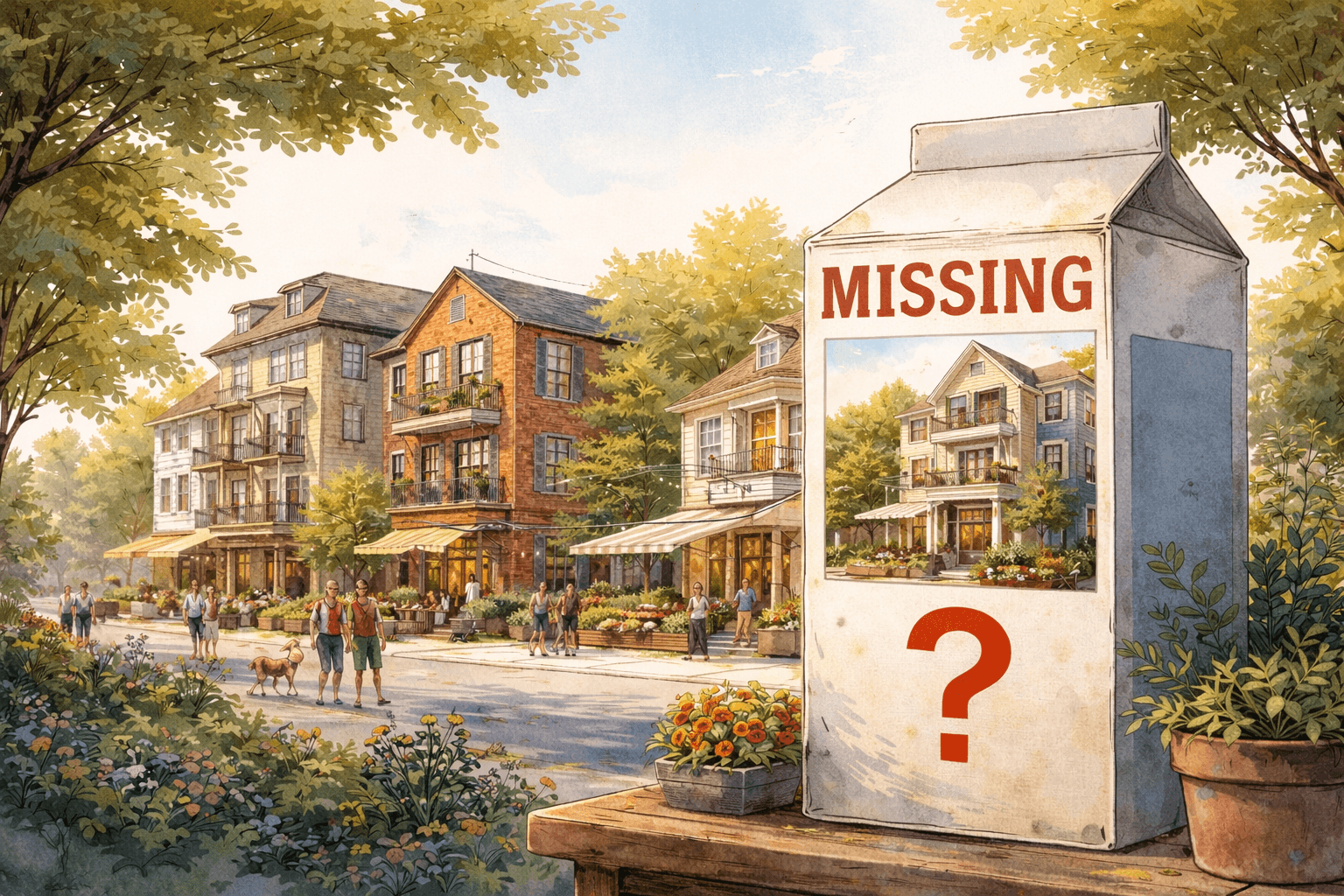
The Missing Middle
At one point there was a form of development that existed between the extremes of suburbia and high rise towers often planners refer to this as missing middle housing. Missing middle housing sits between the single family homes that dominate suburban neighborhoods and the high density apartments or condominiums that shape city skylines. These housing types include duplexes, triplexes, fourplexes, courtyard apartments, and small apartment buildings. These developments can sometimes reach 12 to 25 units per acre, which many planners consider a moderate or human scale density. Urban planner Daniel Parolek has a badass book who book Missing Middle Housing: Thinking Big and Building Small to Respond to Today’s Housing Crisis where he says that these housing types historically created walkable and socially vibrant neighborhoods before zoning regulations made them difficult to build in many parts of the United States.
What makes these communities interesting to me is that they still offer people individuality while encouraging interaction it allows us to be individuals in a community and they have a smaller footprint per dwelling but allow more people to live within the same area without making the environment feel overly compact. Often these developments include shared spaces like courtyards, gardens, or walkable streets.
A Personal Memory About Cars
This reminds me of something from when I was younger.
Because suburban environments are so car dependent, walking or biking in the street can actually be dangerous. I remember riding my bike down a driveway once when I was younger. I stopped to talk to some friends, and after our conversation ended in typical kid fashion where I was probably trying to show off, I sped down the hill. What I did not realize was that in that brief moment the setting had changed. A Toyota truck was coming up the street straight for my ass. We met right at the intersection and my bike was ripped in half. I flew about 8 feet away somehow I walked away with only a few scratches. I genuinely do not know how I survived. I promise I am not Superman. Also kids, wear your helmet. But situations like that happen in car dependent environments. Pedestrians are often an afterthought. That is why it is common to see those Kids at Play signs in neighborhoods. They are reminders that humans exist in spaces that were designed primarily for vehicles.
What Density Gets Right
There is something that higher density environments get right. Local businesses become possible and easy to access. In New York City someone can walk downstairs to a local bodega instead of driving across town. When I visited San Francisco for the Outside Lands Festival I noticed something similar. There were several small grocery stores within walking distance that carried items you would not normally see in a large superstore. Missing middle housing could incorporate similar ideas. Small neighborhood shops, shared services, and local amenities that people can reach on foot. University campuses actually provide a good example of this. Many campuses include small shopettes where students can buy everyday necessities without driving across campus. Eastern Kentucky University has them and The University of Kentucky has them too. Many stay open late and some nearly twenty four hours.
Places like that keep money circulating locally while also giving residents convenient access to what they need.
Somewhere In Between
So what is peak density for humans? Not density measured purely in profit, but density measured in how people actually live. Some urban planners often point toward a range somewhere around 15 to 30 units per acre as a kind of middle ground. Dense enough to support walkability and local businesses, but still low enough that buildings remain human in scale and people maintain a sense of individuality. That range happens to be very close to what missing middle housing tends to produce. Density is not just a number. It is also about how spaces are designed, how streets function, and how people interact with the places around them.
A Thought to Leave With
Peak density seems to be about proximity. Proximity to other people, to shared spaces and to the small interactions that slowly turn strangers into neighbors. Cities figured out how to bring people together, the downside here though is sometimes at a scale that feels overwhelming. Suburbs figured out how to give people space the downside here though is sometimes at the cost of isolation. Somewhere between those two extremes there might be a quieter balance. Where you don’t have to choose. If that balance exists, it might not be found in the tallest towers or the widest suburbs. It might be found somewhere in the middle.