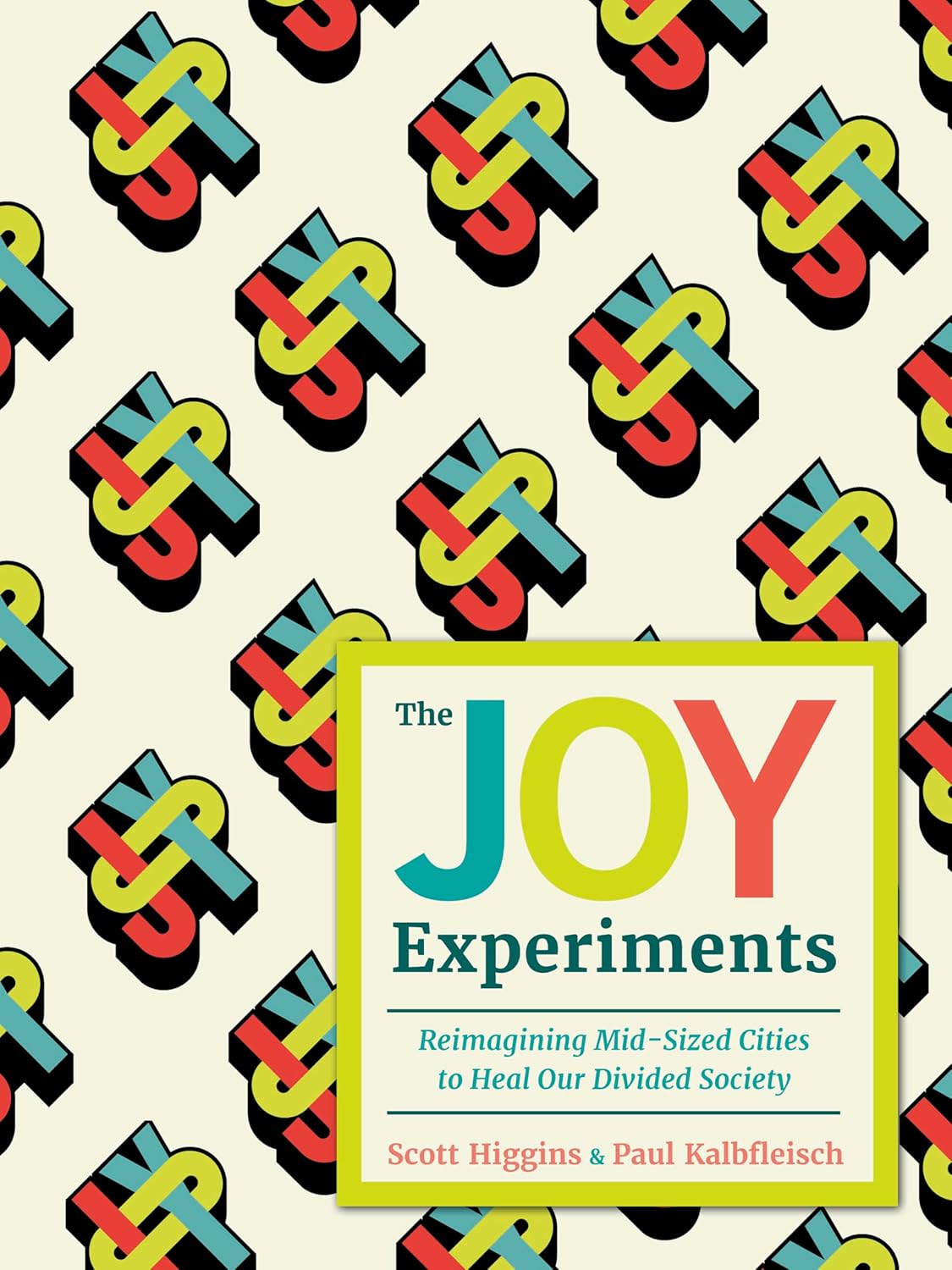
On "The Joy Experiments: Reimagining Mid-Sized Cities to Heal Our Divided Society" By Scott Higgins and Paul Kalbfleisch
First Impressions and the Framing of Joy
This was an easy read, a book that even included pictures throughout, with some spreads taking up multiple pages. It is around 200 pages, but realistically it could have been closer to 160 if the graphics were removed. That said, not all of that was unnecessary. Some of the images actually reinforced the book’s points and case studies.
For example, the book discusses a project that received the Joy Experiments Award for Merit, where Brenda Reid, through community collaboration, created an individual quilt. Each block represented the shape and size of a face mask during the pandemic. It connected directly to the effects of COVID-19 and the isolation people experienced during mandatory social distancing. The final quilt told 550 different stories and stretched to 25 feet long. This was a clear attempt to emphasize the authors’ main focus of creating a system of joy within the built environment, with a strong emphasis on community.
That idea of joy is further expressed through the recurring theme of Live, Work, Play, which the authors present as their ideal formula for city building. As they state, a redistribution of policy making and city building energy and investments in the following way will get us closer to cities that are truly sustainable in the 21st century, Play 35 percent, Live 35 percent, Work 30 percent. I do believe joy is necessary, and I agree with parts of their argument, especially the Live, Work, Play mindset. But this raises a real question. What does joy actually mean in a built environment beyond just selling a hopeful vision?
Joy as a Byproduct and the Case for Contentment
Joy should not be the ultimate goal of city design it should be a byproduct of something deeper and persistent. The book positions joy as the target, but in reality joy is unstable. It comes in peaks and fades. Designing for joy alone risks creating environments that chase emotional highs without accounting for the full range and complexity of the human experience.
A more grounded goal would be contentment. Contentment is not as exciting or marketable as joy, but it is far more sustainable. It allows for the natural fluctuations of life, the reality that not every moment is joyful. In natural systems there are cycles of growth and decay, stability.. Cities should be designed to support people through all of those conditions, not just the ideal ones. The authors hint at this through their focus on community, identity, and shared experience, but they stop short of fully committing to it. What they are circling is not just joy, but the creation of environments where people feel grounded, connected, and supported over time.
Mid Sized Cities, Experimentation, and the Missing System
The book focuses heavily on mid sized cities and provides various case studies, but ultimately it reads more like a a detail sheet than a fully developed blueprint. It offers ideas that are easy to grasp for a wide audience, developers, planners, architects, and everyday residents, but it stops short of providing a clear roadmap for execution.
To their credit, the authors acknowledge that these are experiments and that failure should be accepted as part of the process. That is valid but I’d argue that even within experimentation there must be a feedback loop if these ideas are to operate within a capital driven environment, there has to be a way to measure success.The question then becomes how does a community actually build contentment while still preserving individuality?
Building Contentment Through Systems, Identity, and Design
Contentment cannot be left to chance or assumed through good design alone. It must be supported through measurable systems, spatial decisions, and cultural identity working together. This is where frameworks like the Happiness Index become useful, not as a perfect solution, but as a starting point for understanding whether a community is actually improving people’s lived experience. If contentment is the goal, then it must be tracked, evaluated, and adjusted over time. Without measurement there is no feedback, and without feedback there is no real progress.
At the same time, proximity plays a critical role. Concepts brought up in the book like the 15 minute city begin to address this by reducing friction in daily life, placing essential needs within walking distance and allowing people to engage more naturally with their environment and each other. This allows interaction and makes it a byproduct of the everyday.
Equally important for these cities is a sense of identity. When people feel connected to the identity of a place, whether through shared rituals, local expression, sports teams, or collective memory, they are more likely to invest in it and embody the mythical ethos. This is what makes a system repeatable. Each community can develop its own character while still operating within a functional structure and even tourism allows people to have an individual authentic experience of that location when they experience it.
Design plays a role in reinforcing this, but only when it prioritizes people over systems built purely for efficiency. Human centered environments through scale, walkability, and curvature encourage movement and interaction. When spaces are designed for people rather than vehicles, they naturally support stronger social bonds. When individuals feel connected, supported, and involved, they begin to uphold the environment around them. This is where the book’s idea of a faith in community begins to take shape. People take care of spaces because they see themselves as part of something larger. The book’s chapter Community is the new faith explores the decline of traditional religiosity and reframes it as an opportunity. Instead of relying on organized religion, meaning can be grounded in community itself. With elements like shared spaces, identity, leadership, and participation, community begins to function as a kind of modern faith. It can feel slightly idealistic, even a little cultish but the underlying idea is strong. When people genuinely invest in their community, the outcome can be more connected and supportive environments.
Economic Reality and Final Reflection
The book does not fully address the economic structure required to sustain these environments. Community cannot exist outside of capital. The most effective environments are those where social connection and economic activity reinforce each other, where value circulates locally, much like your local farmers market. Without this, joy risks becoming an added cost rather than an emergent benefit of a well functioning system.
Overall, this is a book that I did enjoy. It presents a hopeful and engaging perspective, but it lacks depth in critical areas. The case studies could be more detailed, and more importantly there is little discussion of financial performance, profit, loss, or long term feasibility. It focuses heavily on aesthetics and experience without fully addressing execution.
At its core, this is a strong piece of hope driven thinking. But for these ideas to move beyond aspiration, emotional experience must be grounded in systems that can be measured and sustained. The most successful communities will not be those that simply pursue joy, but those that create the conditions, the contentment from which it naturally emerges. Much like nature, a community built on resilience, adaptability, constant change and an appreciation and respect for it’s complexities rather than not addressing its reality can lead to a better system of life.