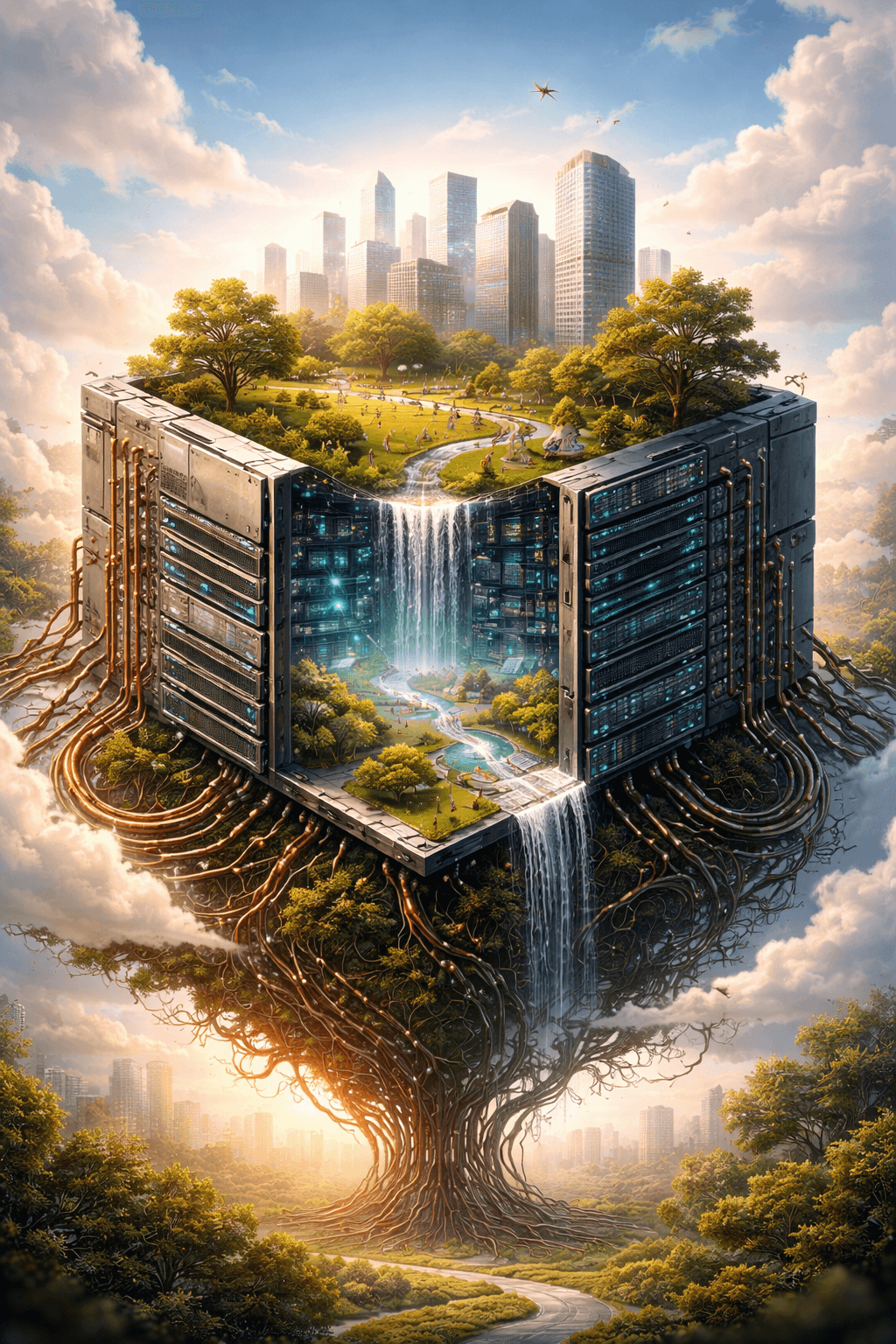
Why does the future of AI look like a warehouse... when it could feel like a park?
Coming to a Town near you
They’re big, they’re clunky, they’re hated by most but used by all. Ladies and gentlemen, coming soon to your local area is the next data center.
And here’s the real question nobody is asking out loud.
Why does the future of AI look like a warehouse when it could feel like a park?
We are about to flood cities with data centers, I mean it seems everywhere one is popping up or trying to. Over 500 billion dollars is being poured into them globally, and they are showing up like weeds. But at the same time, communities are pushing back just as fast, many despise them. Places like Peculiar, Missouri and Monterey Park, California are already saying no. And honestly, they are not wrong. These buildings take. They take water, sometimes millions of gallons a day. They take power, with regions like Northern Virginia seeing data centers consume over 20 percent of their electricity. They take land, often in places where communities could have had something that actually serves them.
And what do they give back? Nothing you can touch. Nothing you can use. Nothing you can gather around. These data centers give back what some people call A.I slop. And we know slop is fed to pigs because they’ll eat anything. If people are being fed only slop from these data centers the question they ask; why would we want this here? In our community? Where I live? Why not somewhere else, or not at all?
Why We Hide Them And Why People Push Back
But if we are being honest, this is not new. We have always hidden the systems that make our world work. Through zoning laws, things are placed in specific locations.Warehouses go in industrial zones, sewage gets pushed away, power plants are placed far from where people live.Out of sight, out of mind. It looks better. Feels cleaner. It feels like everything just magically works and that it always will. But that illusion does come at a cost. It disconnects people from the systems they depend on every single day. And now data centers are stepping into that same role, hidden, isolated.
When people push back, it is not just about infrastructure. It is about community. Nothing brings people together better than a shared hatred for something or specifically a shared goal of hatred for something. Entire neighborhoods will organize and push back against a single project. That tells you something. People are not just reacting to what data centers are. They are reacting to what they are not. People are reacting to what they represent, which is exploitation without reciprocation. To some these data centers are not useful, not welcoming, and not part of everyday life. They just show up, drink all the water, and sit there pumping out meme videos.
We Already Solved This Once
We have already seen what happens when you stop hiding infrastructure and actually design it for people. Look at the Bjarke Ingles Group Amagar Bakke energy plant in Copenhagen. This is literally a waste-to-energy plant. The kind of thing every city tries to hide because it is ugly, industrial, and nobody wants to look at it because you think, oh everybody shits. And instead of hiding it, they turned it into one of the most interesting public spaces in the city.
There is a ski slope on top of it. A climbing wall on the side. Trails, views, space for people to actually go and enjoy it and take a deep breath (Next to where waste is being processed).Think about that for a second. Something that was supposed to be hidden became something people choose to go to. That is not just good design. That is a completely different mindset.
And it is not just a one-off idea. In Helsinki, waste heat from data centers is already being used to heat thousands of homes. In Sweden, Stockholm Exergi is doing the same thing, taking something that would have been wasted and turning it into something people actually benefit from. So this idea that infrastructure can give back, that it can be part of daily life instead of hidden from it, is not some fantasy. It is already happening.
From Boxes to Systems That Give Back
So now the question becomes simple. Why are data centers still just boxes?
Because when you really think about it, they produce a lot more than data. They produce heat, enough to heat homes, pools, greenhouses, even entire neighborhoods. They use water, so why are we not designing closed-loop systems or reusing it? They take up land, so why not give some of that land back? Right now the relationship is one sided. Humans use AI, AI requires data centers, and data centers take resources from communities. That is where it stops.
But what if it did not stop there? What if it was symbiotic?
A system where the community supports the infrastructure, and the infrastructure actively improves the community at the same time. Lower energy costs, shared spaces, real physical benefits. Now it is not just a data center it becomes a community hub. A place where you can schedule to meet up just for the aesthetic, a place to take prom or engagement photos.
And this is not some far-off concept either. Picture this actually happening in a real neighborhood. A developer comes in and says they are building a data center. Normally, everyone would fight it, but if the focus is on building a data center that is human centered it may have less haymakers thrown. Part of the building is still the data center, locked, secure, doing its A.I thing. But the roof is a public park. Not decorative, a real one. Running paths, shaded areas, places people actually use/ take pictures. Hell maybe even a local ski slope.
The excess heat is piped into a small community center next door. Now you have a year-round heated gym, maybe even a pool or community spa. Something people would have had to pay a lot more for otherwise. Inclusivity here is appreciated because it’s using everyone’s shared space/
Instead of just fencing the whole thing off, parts of the ground level are designed as usable space. Not fully open, but intentional. A place where people can exist around it, not just be pushed away from it. Now the conversation changes. It is no longer, “why are you putting this here?” It becomes, what are the “hours of operation? How do we book time in the spa? How much does it cost to swim at the pool or climb the rock wall?”. Now with the developer it becomes not a forceful extraction but a conversation of opportunity.
Your local Community Intelligence Center
Imagine your city’s most important building is not a stadium or a mall, but a data center. Not because of what it hides, but because of what it gives. A place where people walk, run, relax, and meet each other. A place that actually improves daily life. And honestly, maybe part of the problem is the name. “Data center” sounds cold and industrial. What if it was something closer to what it actually becomes? A community intelligence center. Something like a library or a gym, but for the future, a new modern look at our collective future. AI is not going anywhere, the genie has been let out of the bottle. But with the right wishes and deliveries we can create a better world.
Right now we are building warehouses and acting like that is the only option because we are wanting to deliver efficiency or these businesses are. But it is not. We have already proven infrastructure can be something people enjoy. We can demand better and everyone can still win. There was once a time where libraries, hospitals were built from the riches of the rich as a public service, data centers or should we now push for them to be called Community Intelligence Centers are just the new method of delivery for a stronger more human and symbiotic community.