The Most Useless Crop in America
Where I’m From
A little about me, I grew up in the suburbs within the city limits of Richmond, KY. The houses, other than slight variations, were typically the same, and there were multiple streets with cul-de-sacs. Along with typical weekly lemonade sales, kids playing in the streets, and maybe a couple basketball games played in the driveway on mobile hoops, usually set to the height where the kids could actually dunk and feel like they’re in the NBA, things in the suburbs are pretty similar.
There are brief moments of individualization. The landscaping of flowers you have, the way one house decorates, or how Mr. and Mrs. Johnson on Saddlebrooke turn their driveway into a “haunted house” every Halloween. But one thing that does remain is that every weekend there will be that churn of machinery, and that smell of fresh cut grass. Miles upon miles of manicured and treated lawns.
Even the green spaces that some HOA’s have to take care of are being cut by someone. Those empty spaces that offer imagination for kids playing must be maintained. Like clockwork, every weekend there are lawns upon lawns of those horizontal freshly cut lines.
The Culture of the Lawn
My father was no different. Neighbors often remarked on how beautiful his yard was. There would even be times when we knew one of our neighbors was going through difficult health problems before they even told us, just because we noticed their grass was slightly taller than usual. That’s how “pristine” it was kept.
When I was younger, I thought the yellow dandelions that popped up everywhere were beautiful. They gave color to a majority green lawn. Little did I know that those would be considered weeds and unwanted. Even blowing a dandelion and making a wish, something that made the lawn interactive, was not wanted either. What was really wanted was the fresh grass and its rows of being cut. Does it add value? Maybe aesthetically. Can we eat it? Not unless you want to get sick. So why do we keep it?
My Reality Now
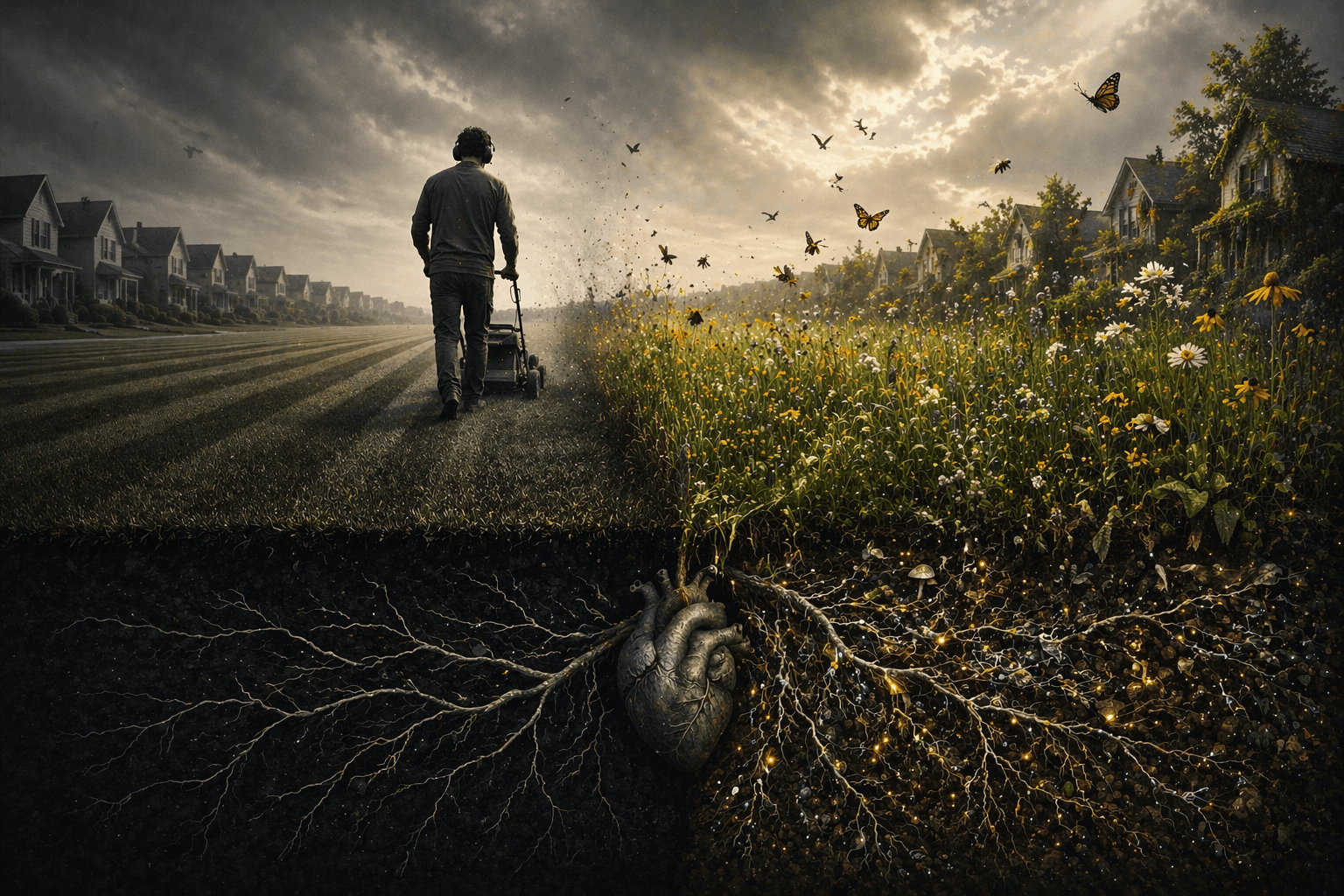
Now that I am older and own my own home, I have had to come to grips with these conversations. I do not live in an HOA, selectively, but there is still control. I typically hate cutting my grass because I do not find value in cutting down an environment. I actually like seeing the tall biodiversity of weeds, but the city does not, and neither does my partner. We had code officials called on us one time due to our grass being “too tall,” and we were told if we did not maintain it there would be financial consequences.
I was perplexed. We were encouraged to disrupt biodiversity. There were bees flying all around, pollinating the ground and flowers, yet they saw it as an out-of-control lot. My opinion was that the code officials could kick rocks. That answer did not suffice with my partner.So the result was, I cut the grass. The bees reduced. The yellow dandelions were gone. The wishes that could be made were nonexistent.A part of me felt sickened as the blades tore through the lawn. Almost a sense of compassion for the destruction of what I felt were homes.
I was confused. Why do people prefer a society of inefficient, characterless lawns instead of a diverse ecosystem? And even more, why do people so eagerly abide by this system of conformity?
Where Lawns Actually Come From and The American Lawn
So the modern lawn that we know today comes from European aristocracy, particularly in France and England. This was an era where everything was attempting to be picturesque, a controlled opposition to nature. It was a way of showing human prosperity, the ability to reign in nature’s complexity. You could even see this in the art of the time. Many landscape paintings showed a controlled version of the natural world. Large grassy estates became symbols of status and wealth. Especially when manicured, it showed that someone could be hired to maintain this aesthetic.
Here in the United States, things evolved. Especially around the time of World War II, people returned from war and began shifting away from agrarian lifestyles into more industrial ones.
With that came a shift in status and perspective, moving toward a consumer-based economy. Developers began pushing the idea of the “perfect lawn” as something that coincided with the American home. Think white picket fence, one-car garage, two smiling kids, all in front of a perfectly manicured yard. Who would have thought that the lawn was a manufactured aspect?
This helped instill both individuality and conformity at the same time, pushing many toward what we call the American Dream.
The Scale of Conformity
What has been found is that lawns now cover over 40 million acres in the United States and consume about 9 billion gallons of water per day. Now these lawns are so ingrained in our society that we do not even think twice when people cut them. In some cases, when someone does not, it stands out immediately. Almost like spotting a flea in milk.
This is the degree of social pressure. HOA’s, neighborhood expectations, and even economic forces all play a role. In real estate, there is something called curb appeal. Realtors and real estate professionals understand this well. Homes with strong curb appeal, well staged and manicured, often sell for higher prices than homes that do not. Overgrown bushes, tall grass, anything that breaks the visual expectation is seen as less valuable. So lawns, when maintained, become a form of conformity. When nature is allowed to grow naturally, it can result in fines, like what happened to me. A real financial consequence for nonconformity.
Control vs Nature
Individuality seems to be accepted only within controlled limits. When nature actually begins to thrive, when it grows in abundance, it creates discomfort. It becomes labeled as unpredictable, complex. And when things become complex, people want control. If you do not believe me, go outside, take a cup of grass, and eat it. It does not turn out well.
The American lawn is the most widely grown crop in the country. And we cannot eat it.
It provides nothing but aesthetic value and a social contract of conformity. Some people say they love cutting the grass. Some people find peace in it. But if they did not have to, would they still do it? We already know the answer in the eyes of society. So because they cannot stop, people seem to have changed the narrative of why they do it. Does that make sense?Do you cut your grass because you want to or fear being judged?