We’re Training Builders, We're Not Thinkers
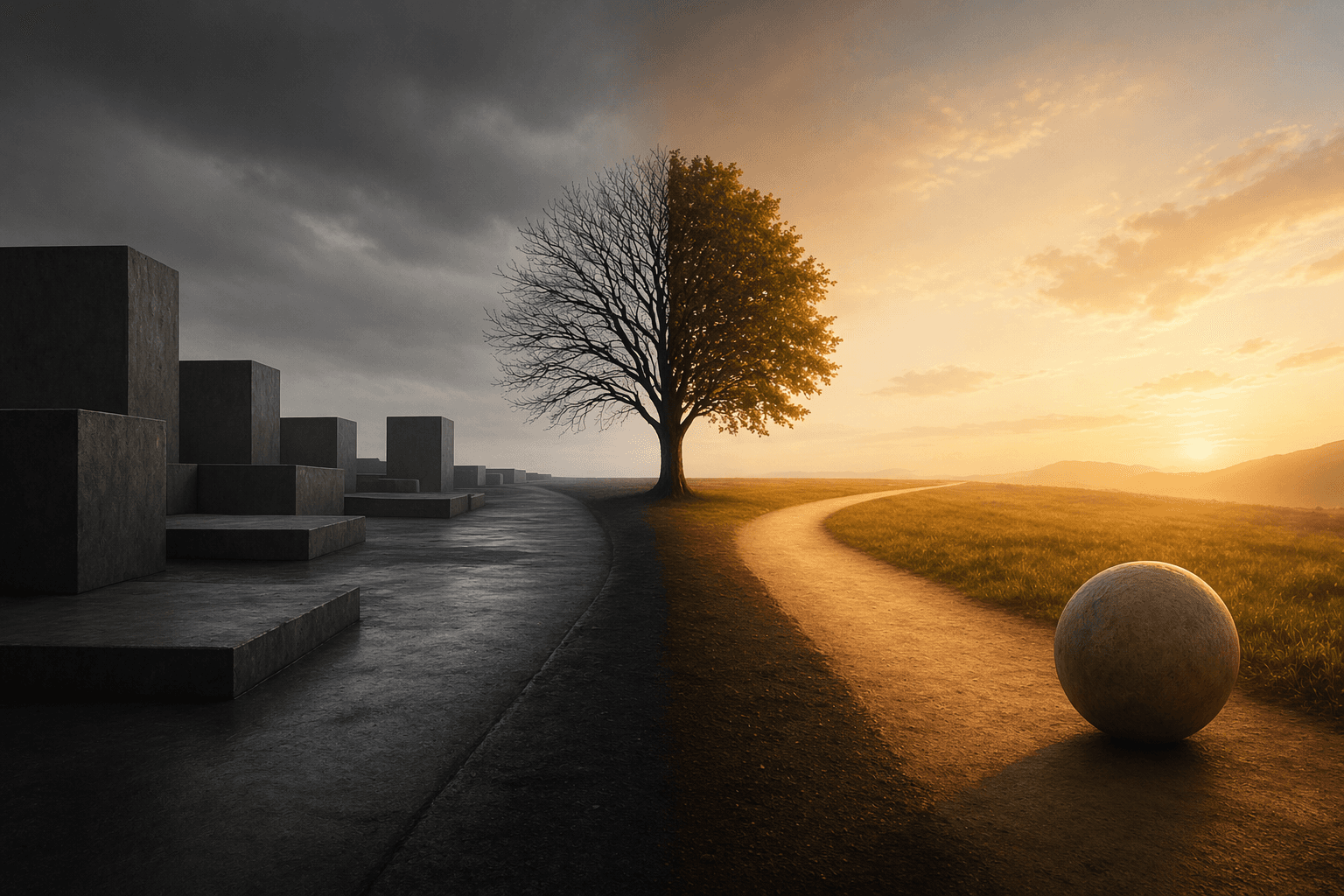
Moore’s Law in Effect
We live in an age of constant change. There seems to be a new shift on the horizon every week: a Moore’s Law-like acceleration of technology, the rise of disinformation campaigns, huge leaps in advancements in AI, and global geopolitics completely shifting from what it once was.
Now we are moving toward a more abundant world as well. A favorite book of mine, Humankind: A Hopeful History, discusses how things are not as bad as they seem and people are not as bad as we have been taught to believe. Bregman argues that “most people, deep down, are pretty decent,” challenging the assumption that humans are inherently selfish or violent. We are in an era of vast information and a machine that can connect us with almost anywhere on Earth in seconds.
Paleolithic Minds in a Digital World
The downside to this is that we are still Paleolithic creatures by nature. Think about that. There was a time when the only thing we were aware of was the immediate threat around us. This assisted in our survival. It helped us operate in fight or flight mode and kept us alive by knowing when to go into each. When we saw an apex predator, we knew what we had to do through trial and error to survive. We entered that mode, that hyperawareness when danger is lurking, and it has stuck with our species ever since.
What has changed is the degree of danger. With this large access to information, we can feel the psychological effects of fight or flight being triggered by things happening hundreds or thousands of miles away. These are not immediate dangers to us, but they feel like they are because our primitive emotions do not decipher the difference.
Progress Is Real But It Feels Off
As discussed in The Rational Optimist by Matt Ridley, things are moving in a more positive direction than what the news may make it seem. Ridley writes that “the world is getting better… in most measurable ways,” pointing to longer life expectancy, reduced poverty, and increased access to goods and knowledge. Even with that being said, there still seem to be things that take away from our collective humanity.
The Push for Practicality
Jensen Huang, current CEO of NVIDIA, has stated that electricians and plumbers will benefit from the AI race and become six figure jobs. Geoffrey Hinton, often referred to as the Godfather of AI, has mentioned that it may be wiser to become a plumber due to potential job displacement caused by AI advancements. This comes on the back of evidence that those who hold a computer science degree are having a harder time finding jobs in the market. The unemployment rate for computer science graduates was around 6.1 percent in 2025, influenced by automation, oversupply of graduates, and tech industry layoffs.
Interestingly enough, this was a degree that, in the mid 2010s, many people were encouraged to pursue because it was one of the hottest commodities. That 6.1 percent unemployment rate nearly doubles the unemployment rate of philosophy majors. Now do not get me wrong, trades are needed. In fact, I have career training as a carpenter, have worked within civil engineering, and am currently in construction management. One of the biggest reasons I transitioned into this field was because I felt it was something considered practical, and I genuinely love the built environment.
Who Builds, Who Questions, and Why It Matters
Though interestingly, these CEOs and pioneers of industries do not advocate as heavily for people to follow the path of the humanities or pursue liberal arts degrees. I must concede that I have been swayed before into believing that a B.S. holds more credibility than a B.A.
Why is that? A system that focuses primarily on production and efficiency is highlighted more than a system that focuses on questioning that production. The B.S. may produce effective systems. But the B.A. questions those systems.
When a billionaire tells you to go into a career, although needed in society, why is it not questioned more appropriately? A world full of robotics and AI may not question the task it is given. Humans do. Humans provide a sense of purpose as to why something is done.
The Question I’m Left With
Now I am not saying that a B.A. is better than a B.S., or vice versa. I am a B.S. student questioning whether we are losing our humanities for efficiency, and whether the only ones who can preserve it are the ones who choose to study it for a living.
What happens when no one is trained to question what we are building?