On "We are As Gods By Peter H. Diamandis and Steven Kotler"
Welcome to the Future
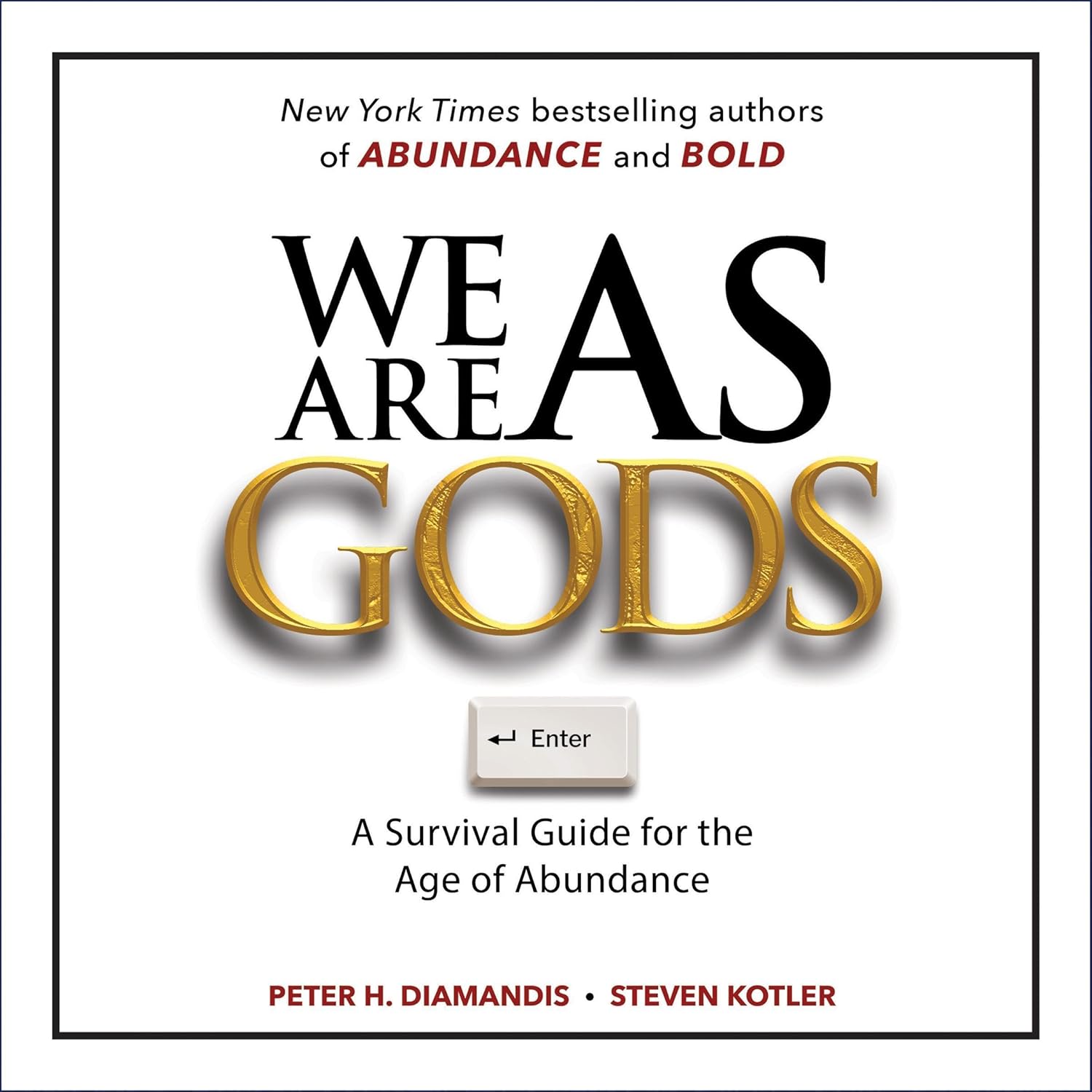
I just completed the book We Are as Gods. This was a book that seemed to dive into the “exponential” effect that artificial intelligence is having on our world. Of course, this book does look at it through a rose-colored lens, that cannot be emphasized enough. I know currently A.I. is in the news for a multitude of things, and a lot of it is negative in our world, taking jobs potentially, surveillance, and it is even being used in war. Currently, during the Iran and USA and Israel conflict, there is a strategy of painting “planes” on the ground that would trick the A.I. systems or humans into bombing these painted spots, believing it was the shadows of the Iranian fleets. This is some Wile E. Coyote type shit. But this book focuses on the good that A.I. brings, so much so that it leads us to the ability of being Gods.
So often we compare what we “think” something should look like or be, compared to the reality of what something is. That’s a mention within the first chapter, that as a society we should “feel” like we are in the future, but we don’t think we are. When in actuality, the future is here. The authors present the aspect of us being the future, with having godlike abilities not just at our disposal but with so much ease that we don’t realize the true magnitude of power a child with a tablet possesses. The authors cover how we, as a primitive mindset, were meant for linear thinking but have the divine capabilities of exponential control. A testament they address by, “If the divine feels distant, it’s because our brains weren’t built to process miracles at scale”… what are these miracles that we see on a daily basis?
Quantifying the Divine
Well let’s compare to some of the miracles that God would be able to perform. Beyond morality or scripture, God is able to create something from nothing, God possesses omniscience, the ability to know all things, God also omnipresence, the ability to exist everywhere at once. The authors even go as far as to quantify the amount of miracles performed in the Old Testament.
Creation Miracles: 1
Provision Miracles: 10
Nature Miracles: 16
Healing Miracles: 7
Resurrection Miracles: 3
Judgement Miracles: 15
Protection Miracles: 15
Prophetic Miracles: 9
Communication Miracles: 5
Victory in Battle Miracles: 5
Total Old Testament Miracles: 83
Now if we quantify the “miracles” performed by everyday citizens in a single day, the scale shifts completely:
Creation Miracles: 10,000,000,000+ — people creating content, code, ideas, and entire digital spaces out of nothing.
Provision Miracles: 500,000,000+ — food, goods, and resources delivered across the world within hours.
Nature Miracles: 10,000,000+ — controlled environments, agriculture, and systems shaping nature itself.
Healing Miracles: 50,000,000+ — medicine, treatments, and diagnostics restoring and extending life daily.
Resurrection Miracles: 10,000+ — lives saved through emergency response and life-support systems.
Judgement Miracles: 10,000,000,000+ — decisions made constantly through systems, data, and algorithms.
Protection Miracles: 10,000,000,000+ — threats prevented through security, monitoring, and safety systems.
Prophetic Miracles: 10,000,000,000+ — predictions made through data, patterns, and forecasting tools.
Communication Miracles: 100,000,000,000+ — instant global communication happening nonstop.
Victory in Battle Miracles: 1,000+ — conflicts influenced through technology, strategy, and systems.
Now the list of miracles in the Old Testament is exhaustive, and I’ve never taken the time to quantify. The weird thing is when you quantify miracles, it sort of seems… obtainable. Now please don't strike me down as a heretic but from daily use of individuals, deciphered from the information above, we have surpassed 83 miracles. Thus, the deeper conversation and argument the authors make within this book and A.I. is that some of these miracles, we are on the verge of accomplishing at a grander scale.
From Miracles to Tools
For instance, there is evidence of using A.I. companies have assisted in providing sight to those previously deemed blind, including work being done by Neuralink and other neurotechnology groups attempting to translate brain signals into visual perception. Being in the beginning stages of this technology, there should be no reason that through funding and research, and a utilization of A.I. to scour appropriate academic articles and research papers, that this technology cannot only scale but also become drastically cheaper and more accessible to those in need. Giving the blind an ability to see again was deemed a miracle, now we’re moving toward a world where it’s just another tool in the human tool chest of technologies.
Or how with Neuralink and technologies similar, using nerves and computer orchestration, trials have already shown patients being able to control digital interfaces with their mind, signaling the early stages of restoring movement and communication for those who were previously paralyzed.
The Toddler and the Gods
Discussing back to the ability for a toddler to have the capabilities of godlike behavior, you have to look no further than your smart device. As these younger generations are growing up, they are becoming more intertwined with the technologies already incorporated into our world. Now I will say too much can be bad with respect to everything, but these toddlers can literally call someone on the other side of the world and communicate with them (beyond goo goo ga ga, I’m sorry I don’t know how toddlers speak on the daily). This ability gives a toddler a version of omnipresence that kings of old times could not even fathom.
As for omniscience, we have millions upon billions of pieces of information at our fingertips utilizing tools like ChatGPT, Claude, Google, Bing, and more. Combine that with the historical evidence we have of books already written and potentially uploaded for our access, we have all kinds of knowledge we can access. That is just considering knowledge of genuine value.
The Illusion of Knowing Everything
If we move to more novelty knowledge, we have that too. There is a conversation of high school reunions for the younger generations not being that popular. I currently am organizing our 10-year reunion, and I did not care to do it, but it was something I agreed to when I was younger, so I said what the hell, why not, we’ll see. Though the engagement online is pretty high, the actual aspect of everyone meeting in person is low. Now of course high school could have been a troubling time for some people, and I do understand that, but this is a common theme of people not wanting to go or even interact with their high school reunion.
My theory is that we don’t need to see everyone in person to actually keep updated. There was a time where after someone graduated, they never saw someone again, they knew nothing about their classmates, they had no idea. Now we live in an age of connectivity. The people I want to keep up with, I can literally send a request on Facebook, Instagram, or TikTok and get an update. Most recently, I found out one of my old friends I haven’t said a word to since high school has gotten married and has a baby. Beyond that, what more am I requesting of these people? Even these novelties of knowledge about small changes and updates in past relationships are a form of omniscience that we have in the present age, this knowledge of “all knowing,” I guess with an asterisk, because it would be all knowing of what I actually care about.
The Promise of Abundance
This book does a great job of talking about the benefits of A.I., from food being grown in labs, such as cultivated meat developed by Upside Foods and Eat Just, to organs and medical supplies being delivered in Africa much quicker through drone networks like Zipline, to centaurs, the combination of using human intuition and creativity with A.I. data processing, a concept proven in advanced chess competitions where human and A.I. teams outperform either alone. Though it does discuss something that should plague us… abundance. What happens to us as humans when we win the “game” but still have to play?
Now as many of you may know me as a SolarPunk enthusiast, abundance is one of our goals, but the fear of abundance does linger within me, and it appears these authors do too. That fear comes from the mice experiment Universe 25 experiment, where the mice had everything they could have ever wanted and came to a point of not wanting to do anything and ultimately the species died out, no challenges, no purpose, so they gave up. That would be a sad ending if the human race experienced the same.
The Final Question
If we have abundance on Earth, are we able to take that beyond space? In my thought, we would have to. Earth wouldn’t be large enough for us not to. We could think with the mindset of different frontiers and explore further, K. Eric Drexler’s “plenty of space at the bottom” with nanotechnology, now diving into quantum and lower. We could go to the “final frontier” of space exploration and beyond. We could study further the internal complexities of our minds and, different locations, different frontiers. But does that give us the value needed?
The authors briefly touch on this, but I believe this may be the most important discussion. Tools took us from beings who couldn’t survive in the wild to one of the most apex beings on the planet. Now our tools are the same things that could delay our evolution as a species. Our creativity and necessity to innovate is what drives us to survive and grow. Only time will tell if we even see abundance, or if abundance will see our end.