The Human In The Horizon
So I arrive via train to Odawara. My booking was for a 10:05 bus ride that ran continuously from what I saw online, but I was not certain. This was only my second time being in the country of Japan and my first time having organized this outing on my own. Now I was familiar with some Japanese phrases and I was familiar with the efficient Japanese subway system, but beyond that I had hesitation. Not to mention a typhoon was on its way approaching us in the coming days. It could be considered common for the locals, but as for myself this was a unique experience as was what I was attempting to do. Take a trip to the Enoura Observatory.
Beforehand, I tried to take the cheat code route to this architectural wonder and book through some agency, but I did not find any that offered or even knew about this other than the official website. So when getting off the train, I had great hesitation and a bit of irony. I perceived this experience to have a degree of inconsistencies, so when I arrived and did not locate a bus, I instantly called an Uber to hopefully get me to the rest of the destination, for the walk would be approximately 30 minutes which wouldn’t be awful although the rain was coming down pretty heavy.
As I sat there with my partner awaiting the Uber, her keen eye saw a bus pull up that read “Enoura Observatory.” I looked down at my phone and it read 10:05. I thought efficient. I proceeded to pay the 500 yen fee for the cancellation of the Uber and was certain we were in the correct space. I was further vindicated in my opinion when the driver greeted us and said my name “Johan,” making sure it was me. As I compared my name to the others, I would argue from his perspective it was pretty obvious that we were the intended target of his pick up. The other names were written in Japanese characters such as Kanji and Hiragana, common Japanese writing systems as for mine was what I was more familiar with the Roman alphabet characters.
We proceeded to drive through Odawara to the observatory and from there I was only excited as to what I was to see. For I heard of the creator of the Enoura Observatory, Hiroshi Sugimoto, designing this place so that elements of the architecture would align with the winter and summer solstice. Basically overlooking the vast horizon. Giving multiple perspectives and shifts from different locations.
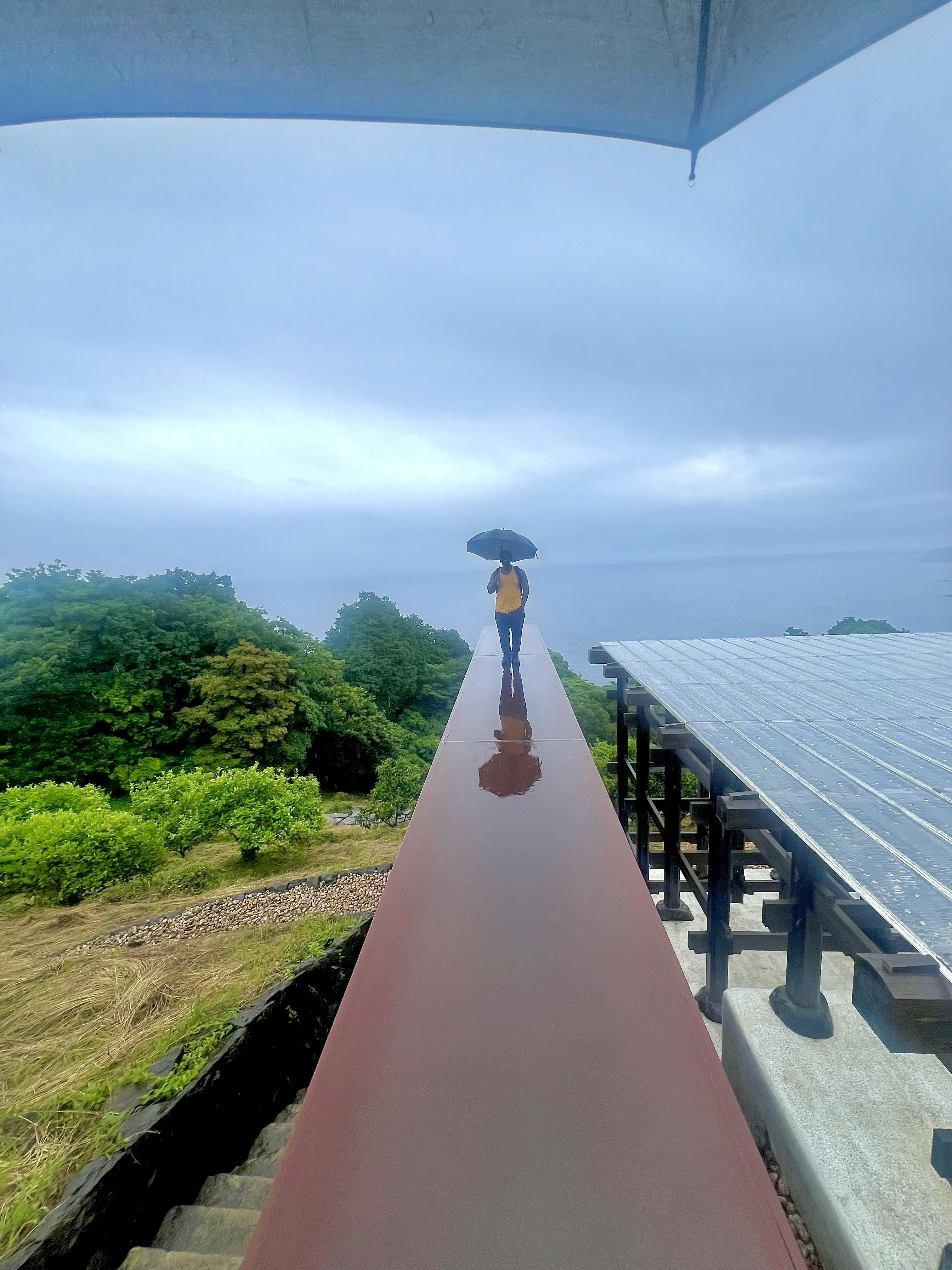
Three different spots I was specifically wanting to see. The top of what I would call the overlook, the Summer Solstice Light-Worship 100-Meter Gallery, which appeared almost metallic and reflective, a structure that was amazing for photos but even better for perception. In the way that you could look out into the vast landscape or seascape because the horizon went on for days, like an abyss that doesn’t end. If given the opportunity to view forever I would see the back of my head looking beyond. Within that glass and steel gallery was an echo of noise, a solace. If you spoke within the gallery it roared with the speaker’s voice, and rang through the entire structure. On the completely opposite side is the beginning of said gallery that peered to a light at the end.
Now in all fairness I never saw that gallery completely empty with 100% light visibility from the other side. There was always someone there, another observer, another being having their perception shifted by the structure and the sound it permitted when audible. Walking through, you have to move at a slower pace.
All of this was adjacent to the Stone Stage that the artist/architect included. It reminded me of a pilgrimage. Although not religious, it felt spiritual. The Stone Stage was facing forward, yes there was a performance space, but when I was within the space the stage itself was overlooked, almost forgotten because the true show was the horizon. Although the horizon did not move and barely shifted, it was in a sense forever moving and forever changing, like one’s perspective. A show that goes on forever with the scenes never repeating.
The architect here makes the piece itself seem like a lens. It forces one to focus on the beyond. The glass stage extending outward to get the Instagrammable photo, or to even get an uninterrupted visual, forces you to slow down. Slowing down was necessary because if you fell it could truly be a bit of a danger. But slowing down was necessary to observe what was ahead.
I would ask myself as I was there observing my surroundings, does architecture have to be created for a specific view to create individual lenses for the viewer? Everyone there from all different walks of life all viewed the misty and beautiful horizon. Sugimoto didn’t create the horizon or the view. But he highlighted it. He brought the perception inward and made it a focus, a surreal experience once slowed down and endured.
Surrounded by gardens, walks, Japanese history, bamboo forest, much of what felt localized was connected to celestial events connecting to infinity itself. The architect connects locality and history with the infinite being. That’s what gave me the most joy when I was at this location. It makes me believe how interesting this locality to infinity connection is. It’s truly a paradox because we as humans try to grasp at the infinite and yes I can conceptualize it, but I could never truly grab the horizon. The architect can never truly put the horizon in our grasp. It’s only our perception that changes. Always looking forward, always out of reach.
As mentioned earlier, there was the Winter Solstice Light-Worship Tunnel where from one side you could look through to the other and see the horizon, the light. Though in my earthly experience there was always someone there. They became a part of the focal point of the story I was creating with my experience. From my view this vast godlike abyss of a horizon was interrupted by a finite being, just standing, just being. Seeing others for their experience makes my experience even more surreal. It reminds me of a quote I hear typically online in the trolling environment of TikTok when someone is trying to shame someone for recording something deemed typical. Sometimes people will say, “Be kind, they’re having their first human experience too.” This resonated with me at the Enoura Observatory because as I look at the vast infinity that dwarfs anything I could ever be or see or understand, a person meandering in my perception is further highlighted of their finality and at the same time beauty within their own human experience.